Census Information
UKCensusOnline provides access to complete census records for England and Wales from 1841-1911, Plus census transcripts for Scotland from 1841 to 1901. Our English and Welsh census records also come with access to the original census pages. Census Records are taken every 10 years and were completed on the following dates:
- 1841 - 6th June
- 1851 - 30th March
- 1861 - 7th April
- 1871 - 2nd April
- 1881 - 3rd April
- 1891 - 5th April
- 1901 - 31st March
- 1911 - 2nd April
There were earlier censuses taken in 1801, 1811, 1821 and 1831; however, the lists of names were not collected centrally. You may find that local record offices will hold some of the data.
The later census data is protected for 100 years and is held by The Office of National Statistics, where it remains closed to the public until its release date.
We also provide access to Census Indexes for Ireland 1901 and 1911.
What information can you see on the census?
Each householder was required to complete a census schedule giving the address of the household, the names, ages, sex, occupations and places of birth of each individual residing in his or her accommodation.
On the 1841 census you will see: Name, Age, Sex, Occupation and Address. Please note, when searching the 1841 census, ages up to 15 are listed exactly as reported/ recorded, but ages over 15 were rounded to the nearest 5 years (i.e. a person aged 53 would be listed on the census as age 50 years old).
In 1851, householders were asked to give more precise details of the place of birth of each resident, to state their relationship to him or her, marital status and the nature of any disabilities from which they may have suffered. In 1891, householders were asked how many rooms (if less than five) their family occupied and additional occupational data was collected. The same was true for 1901.
The 1911 is the most informative to date. It was the first census to be completed by the householder (your ancestors) rather than an enumerator. It included extra valuable data such as nationality, duration of current marriage, number of children born within that marriage, number of children still living and number of children who had died.
Details vary for each census return, with the 1911 census being the most detailed. You can see what’s included on UK Census Online in the table below:
| 1841 Census | 1851 Census | 1861 Census | 1871 Census | 1881 Census | 1891 Census | 1901 Census | 1911 Census | |
|---|---|---|---|---|---|---|---|---|
| Name | ||||||||
| Age | ||||||||
| Sex | ||||||||
| Occupation | ||||||||
| Address | ||||||||
| Place of Birth | ||||||||
| Relation to head | ||||||||
| Marital status | ||||||||
| Employment status | ||||||||
| Nationality | ||||||||
| Duration of current marriage | ||||||||
| No. of children that were born | ||||||||
| No. of children that are living | ||||||||
| No. of children that died |
Searching the Census
From the homepage once Signed In, please click the Search tab. You can select Census from the Record Collection box.
You can choose the Year of Census and County if you wish.
You can then enter; forename, surname, keywords and a year of birth:

You can also select the Phonetic option to search for different spellings of a surname, e.g. Bayley, Bailey, Baily, etc. If you select ‘Include Nicknames’ from the dropdown filter, this will include in the results any nicknames, so for example, a search for Catherine with Nicknames included should return results for Kate and Katherine.
A phonetic search is much more refined than the variant searching available on other sites, as it concentrates on looking for a name based on the way it sounds rather than the way it is spelt. This is important as the records of our ancestors were often communicated verbally, for example, a census enumerator asking a householder’s name or a vicar asking the names of a couple to be married. The further back you go, the higher the likelihood of spelling variations, but the way a name sounded stayed consistent.
Please note, however, that you cannot use wildcards if you are using the Phonetic search option.
Keywords – these can be anything you know about your ancestors (if the information was recorded on the census). For example, it could be a Birthplace, whether Head, Wife, Son, Daughter, Servant within the household, an occupation or a Parish Name.
Year of Event – When searching census records, you would use this field to enter your ancestor’s Year of Birth, you can then add a +/- range for that year of birth.
You should then see your results below:
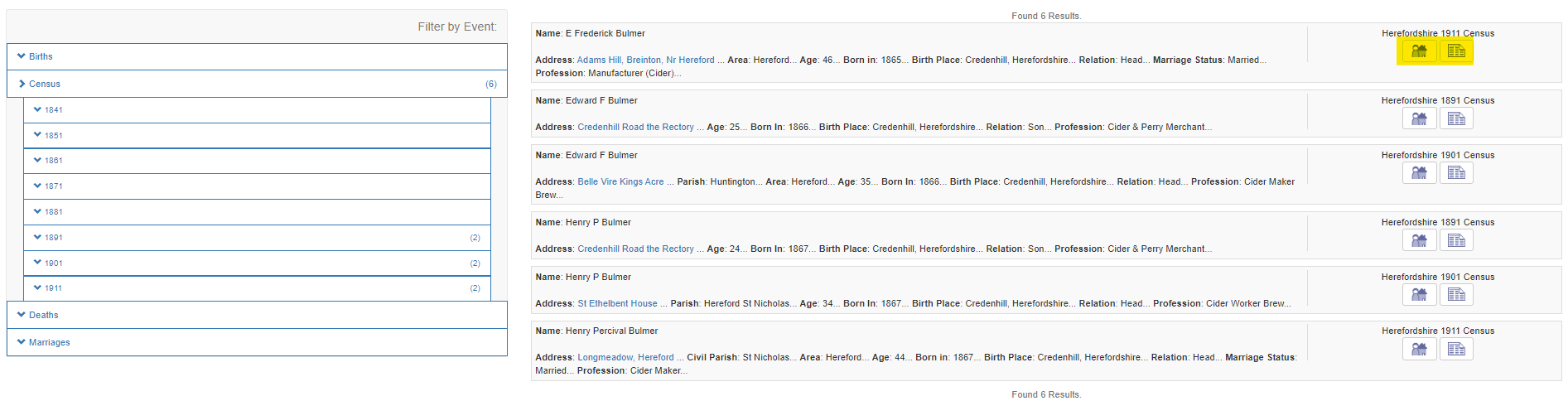
If you receive lots of results, you can use the menu on the left to reduce the number of results to a specific county in a particular year of census.
The icons shown on the right of each record will allow you to View the Record (a transcribed copy of the entries within that household) or View the Image (a copy of the original census page which can be downloaded for future reference).
If you notice a transcription error, you can bring it to our attention using our error reporting system – this is the icon with a question mark that can be seen on the right of entries within a full record.
For Census records, you can either log an amendment suggestion or to have the database amended, or to inform us of a broader error, please contact us using the 'click here' link at the top of the error reporting window. An error report will then be sent to us containing the unique reference number for the particular entry that you wish to query, and you can also add any further comments that may be relevant to the amendment. We can then update our databases.